Table of Content

Mines Game Online: Demo Play, Rules, RTP and Real-Money Wagering, Reviewed

Last reviewed: 2026 | Editorial desk: iGaming research and player-protection review team | Audience: adults 18+ in Australia and comparable jurisdictions

This is a research-led guide, not promotional advice. It combines game mathematics, provider documentation, operator data and peer-reviewed evidence on simulated gambling. If you want practical background reading on the sector, see our iGaming research hub.

Provider

Hacksaw Gaming

RTP

94%

Volatility

Variable

Min bet

0.20

Max bet

1,000

Max win

10,000x

Mines Game Online Demo Play, Rules

Quick verdict before you read further

Mines is easy to learn and unusually easy to check. Three things decide your outcome, and none of them is intuition.

  • The build matters more than the tips. Stated RTP runs from 94% to 99% depending on the provider, so identical clicks pay differently.
  • Mine count is a volatility dial, not an edge. Every configuration returns the same expected value: RTP multiplied by your stake.
  • Speed is the real risk. A three-second round turns a small bet into very large annual turnover, and turnover is what the house edge feeds on.

If you only take one action from this guide, convert the house edge into an expected cost per hour before your first real stake. That number is honest in a way a percentage never is.

Quick verdict before you read further

  1. Scope, methods and limitations

In two sentences: This guide describes how Mines works across the three main commercial versions, how demo mode relates to real-money play, and what the research literature says about simulated gambling. It also sets out the probability mathematics of the grid, the limits of every betting system, and the practical steps for verifying fairness and installing mobile clients safely.

Three categories of material informed this article. The first is provider and operator documentation: publicly available game information pages, help files and rule sheets that state grid sizes, mine ranges, bet limits, stated return to player (RTP) percentages and maximum exposure. The second is peer-reviewed and grey literature on simulated gambling, loot boxes, social casino games and adolescent gambling, principally Australian work published by the Australian Gambling Research Centre (AGRC) at the Australian Institute of Family Studies and associated journal articles. The third is the applied experimental literature on how players interpret RTP messaging.

Several limitations should be stated openly, because a great deal of the material circulating online about Mines is unreliable. First, provider specifications change between releases and between jurisdictions; the figures cited here reflect published documentation at the time of writing and must be re-checked in the game's own information panel before play. Second, no independent, audited dataset isolates Mines specifically from the broader "instant win" or "crash-style" category, so operator-reported figures on engagement and actual RTP are indicative rather than verified. Third, the causal literature linking simulated gambling to later monetary gambling is largely observational, and while the associations are consistent and strong, causality remains partly inferred. Fourth, our internal expert briefing for this piece returned no verified primary sources for certain claims commonly repeated by competitors, notably the origin story of the format and the "official" RTP of some provider builds. Those gaps are flagged in Appendix A rather than filled with guesswork.

Where competitor coverage contains internal contradictions, this guide corrects the arithmetic explicitly rather than silently reproducing it. One widely read strategy article, for instance, states a 99% RTP in its FAQ while its own settings table lists a 2.50% house edge. Both cannot be true. RTP and house edge are complements: they must sum to 100%.

1. Scope, methods and limitations. In

Want to see the grid before you risk anything? On Casino you can open the Mines demo and learn the grid, mine density and multiplier curve without a real-money stake. When you feel ready, move to real play with transparent RTP disclosure and built-in responsible-gambling tools.

2. What Mines game is and how the grid works

In two sentences: Mines is a grid-based instant-win casino game derived from the mechanics of classic Minesweeper, in which the player reveals safe tiles for a rising multiplier and may cash out at any point before revealing a mine. Its commercial implementations differ substantially in grid size, mine range and stated RTP, so "Mines" is best treated as a family of games rather than a single product.

2.1 Grid, mines and safe cells in Mines

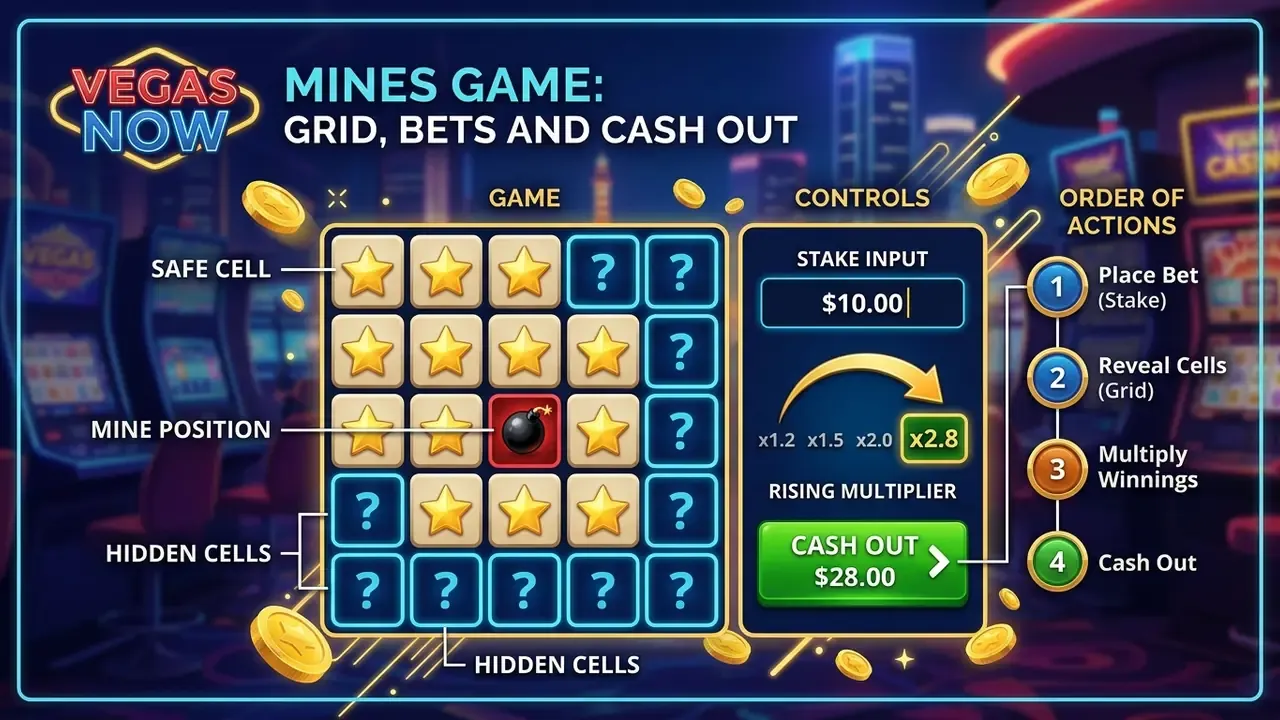
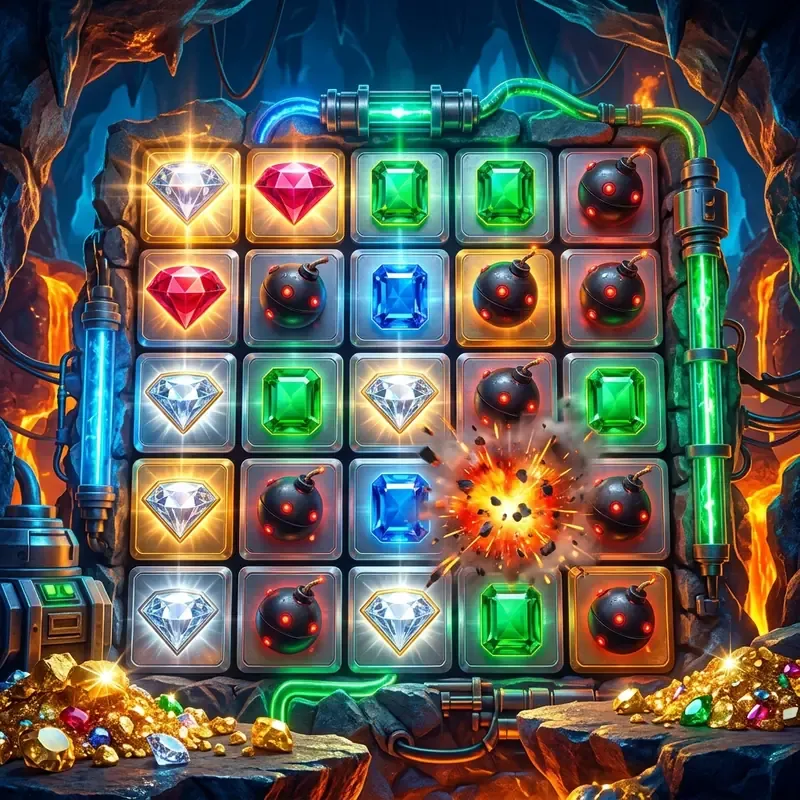
The standard implementation presents a 5×5 grid of twenty-five concealed tiles. Before the round begins, the player sets two parameters: the stake and the number of mines, k. The software then allocates k mine positions at random, without repetition, from the twenty-five available cells; the remaining 25 − k cells are safe and, in most builds, display a gem or diamond when revealed.

Play proceeds one click at a time. Each safe reveal increases the round's win multiplier and grants another pick. Each successful pick also increases the conditional probability of striking a mine on the next pick, because the pool of unopened cells shrinks while the number of mines stays fixed. Revealing a mine ends the round immediately, with the loss of the accumulated round value. There is no partial settlement and no continuation.

2.1 Grid, mines and safe cells

2.2 Bet, multiplier and cash out in the game

At any point after at least one safe reveal, the player may press Cash Out to settle the current multiplier against the stake and end the round. That single button is the whole decision space. Bets set the exposure, mine count sets the shape of the risk, and cash out sets the moment you stop.

Three functional layers sit on top of this loop in commercial builds:

  • Increasing multipliers. The multiplier is not arbitrary; it derives from the inverse of the cumulative probability of the safe sequence achieved, discounted by the house edge. More mines and longer streaks produce steeper payouts.
  • Adjustable difficulty. Mine count functions as a volatility dial. One mine on a 5×5 grid produces a 96% chance of surviving the first pick; twenty-four mines produce a 4% chance and a correspondingly large single-pick payout.
  • Provably fair verification and RNG. Crypto-native builds publish a cryptographic commitment to the round outcome before play, allowing post-hoc verification. Conventional licensed builds rely on certified random number generators audited by testing laboratories. Section 5.3 sets out the verification procedure step by step.

Because the game is fast, low-friction and framed as a puzzle rather than a wager, Mines sits squarely inside what researchers describe as simulated gambling when played in demo or virtual-currency form, and inside conventional gambling when played for money.

2.2 Bet, multiplier and cash out

«Reliable evidence indicates that involvement in simulated gambling, and particularly social casino purchases, is consistently associated with problem gambling.» AGRC Literature Review on Loot Boxes and Simulated Gambling, Australian Institute of Family Studies (2022). https://aifs.gov.au/resources/policy-and-practice-papers/loot-boxes-simulated-gambling-and-other-game-purchases

Some products in this family allow neither real-money wagering nor cash-out. Some allow virtual-currency wagering with redeemable prizes. Others are conventional real-money games. The distinction matters legally and clinically, and marketing copy routinely blurs it.

2.3 Provider versions: Spribe, Hacksaw Gaming and Stake Originals

Before you place a stake, establish which Mines you are playing. The three dominant builds are not interchangeable, and much of the confusion in online guides comes from mixing their specifications.

  1. Spribe Mines. Fixed 5×5 grid with a mine range commonly documented from 1 to 20. Stated RTP is typically 97%, implying a 3% house edge. Widely distributed through mainstream licensed casinos with conventional fiat wallets.
  2. Hacksaw Gaming Mines. Released 3 March 2022 and the most customisable of the three: grid size is adjustable from 3×3 up to 9×9, and the number of active mines can be set from 1 to 80. Stated RTP is 94%, with maximum exposure capped at 10,000× the stake and a documented bet range from 0.20 to 1,000 units. Note carefully: the frequently quoted "Mines RTP is 94%" applies to this build only, and quoting it as a universal figure misleads players on Spribe or crypto-native versions.
  3. Stake Originals Mines. Fixed 5×5 grid, 1 to 24 mines, and the highest stated return in the family at 99%, that is, a house edge of 1%, not 2.5%. Autoplay is available with configurable stop-on-loss and stop-on-win thresholds.
  4. Independent and white-label builds (for example MinesGo-style titles). Rules pages for these commonly state a 97% RTP with stakes from 0.1 to 1,000 coins, plus a fairness or provably-fair verification section accessible from the game interface.
2.3 Provider versions Spribe, Hacksaw Gaming
ParameterSpribe MinesHacksaw Gaming MinesStake Originals Mines
Grid size5×5 (25 cells)3×3 to 9×9 (adjustable)5×5 (25 cells)
Number of mines1 – 201 – 801 – 24
Stated RTP97.00%94.00%99.00%
Implied house edge3.00%6.00%1.00%
Max multiplier / exposureDependent on mine count10,000×10,000×+
Typical bet rangeOperator-dependent0.20 – 1,000Coin/token dependent
AutoplayYesYesYes, with loss limits
Fairness modelCertified RNGCertified RNGProvably fair (seed/hash)
Demo modeCommonly availableCommonly availableVirtual-currency mode

Two practical implications follow. First, an identical sequence of clicks pays materially differently across builds: on a 5×5 grid with five mines, three safe picks return roughly 2.00× at 99% RTP but only about 1.90× at 94% RTP. Second, the Hacksaw build's 9×9 grid with up to 80 mines creates payout structures that are not comparable to any 5×5 game and demands far more conservative bankroll assumptions.

2.4 Demo versus real-money Mines, and classification in Australian policy

Most licensed platforms present demo and real-money Mines through the same interface, with the same artwork, the same sound design and, ordinarily, the same underlying rule set. The switch is a wallet toggle, not a different game. That is precisely why the transition is frictionless, and why regulators treat the pairing as a policy problem rather than a convenience. Players comparing platforms should assess licensing, fairness disclosure and limit-setting tools before depositing, and can start with a licensed online casino offering Mines that publishes both.

The functional differences are worth stating precisely:

2.4 Demo versus real-money Mines, and
DimensionDemo / virtual currencyReal money
Financial exposureNoneFull stake at risk each round
Verification requirementsUsually noneAge and identity verification (KYC) before deposits or wagers
Game logicOrdinarily identical RNG and payout tableIdentical rule set, real settlement
Loss salienceLow, because losses are abstractHigh, because losses are immediate and cumulative
Cash-outSymbolic balance onlyWithdrawable funds subject to terms
Regulatory framingSimulated gamblingLicensed gambling product

In Australian policy terms, the classification question has been squarely raised. Research and submissions from the AGRC argue that games containing gambling-style mechanics, including randomised paid mechanics such as loot boxes and simulated casino play, warrant restriction to adults rather than being available to minors under general classifications.

«The AGRC recommended a mandatory R18+ classification for all simulated gambling games and randomised purchase mechanics, including loot boxes.» AGRC Submission to Guidelines for the Classification of Computer Games (2023). https://aifs.gov.au/resources/policy-and-practice-papers/simulated-gambling-games-and-classification-computer-games

The practical consequence for readers is simple. "Free" Mines is not a policy-neutral product. It is the entry point of a continuum, and the research summarised next explains why that continuum matters.

3. The evidence base on simulated gambling

In two sentences: Quantitative Australian studies consistently find that engagement with simulated gambling products, especially social casino games and paid randomised mechanics, is associated with higher rates of gambling problems and gaming disorder. Qualitative work explains the mechanism: young people frequently do not perceive these products as gambling at all.

3.1 What was reviewed

The evidence base comprises an AGRC literature review synthesising research on loot boxes, simulated gambling and in-game purchases; survey studies of Australian adolescents and young adults measuring participation in simulated products alongside validated instruments such as the Problem Gambling Severity Index (PGSI) and gaming disorder screens; longitudinal cohort analysis tracking the same young people from adolescence into early adulthood; qualitative interview research on how adolescents interpret these mechanics; experimental research on RTP messaging; and submissions from financial counselling and advocacy bodies describing observed consumer harm. Operator-published engagement data supplements this picture but is not independently audited.

3.1 What was reviewed. The evidence

3.2 Quantitative studies of adolescents and young adults

Survey research repeatedly identifies simulated gambling participation as common among Australian adolescents, with representative prevalence estimates for past-year engagement clustering broadly in the 20% to 40% range, depending on the products counted and the age band sampled.

«Reliable evidence indicates that involvement in simulated gambling, and particularly social casino purchases, is consistently associated with problem gambling.» AGRC Literature Review on Loot Boxes and Simulated Gambling (2022). https://aifs.gov.au/resources/policy-and-practice-papers/loot-boxes-simulated-gambling-and-other-game-purchases

The most instructive finding is that not all simulated products carry equal risk. In multivariable models that entered several categories of simulated gambling simultaneously, only social casino game engagement remained a significant predictor of gaming disorder once other variables were controlled.

«Social casino play increased the odds of gaming disorder 2.5 times (95% CI: 1.54–4.02), while spending money on loot boxes increased them 4.6 times.» Hing et al., «Not all games are created equal» (2023). https://doi.org/10.1007/s11469-022-00946-3

Mines in demo or virtual-currency form is structurally a social casino product: a wagering interface, a stake input, a randomised outcome, a multiplier and a cash-out button, with no monetary settlement. That places it in the category the research identifies as carrying the strongest independent association with disordered play.

Sequencing research adds an important nuance. Simulated play does not always precede monetary gambling; for some products, exposure tended to occur after monetary gambling, which complicates any simple "gateway" narrative.

«Young people involved in any simulated gambling product were more likely to have gambled for money and to score higher on the PGSI.» Russell et al., «Order of first-play in simulated versus monetary gambling» (2023). https://doi.org/10.1007/s11469-022-00947-2

The defensible reading is bidirectional: simulated products and monetary gambling reinforce one another, and involvement in either raises the probability of involvement in the other, and of elevated PGSI scores.

3.3 Qualitative perspectives

Interview studies clarify why these associations arise. Adolescents describe gambling-style mechanics embedded in games as ordinary features of play rather than as gambling, which makes it hard to say when they were "gaming" and when they were "gambling".

«Adolescents described simulated gambling as „just part of the game“, not perceiving it as real gambling, which blurs the boundary of risk.» Hing et al., «It Doesn't Give Off the Gambling Vibes», International Journal of Mental Health and Addiction (2023). https://doi.org/10.1007/s11469-022-00948-1

This is directly relevant to Mines. Its Minesweeper heritage, puzzle framing and clean minimalist interface all signal "game", while its structure (variable stake, randomised loss, escalating multiplier, voluntary cash-out) is pure wagering. The visual grammar suppresses the risk cue that the mathematics warrants.

3.4 Industry and advocacy perspectives

Operators publish engagement and performance data that is useful but must be read as promotional and unaudited. The following figures come from a commercial operator report, are not independently verified, and describe one operator's player base over one month rather than the product globally.

«According to the operator KTO, the official RTP of the Mines game is 97%, and in June 2024 the actual RTP reached 97.91%, with an average of 78 rounds played per day.» KTO Operator Report, «Por Que o Mines se Destaca Entre os Crash Games da KTO?» (2024). https://www.kto.com/

Two observations follow. First, a realised RTP marginally above the theoretical figure over a single month is entirely consistent with normal variance and is not evidence of an advantage. Second, and more importantly, an average of 78 rounds per day per engaged player is an extraordinary event frequency. Even at a nominal stake of one currency unit, that is roughly 28,000 wagering events a year, and it is event frequency, not stake size, that drives cumulative exposure.

From the counselling sector, the emphasis lands on exactly that point: harm is not a function of headline stake size.

«„It is not the absolute amount of money that causes harm“: financial counsellors record serious consequences even at low stakes with high play frequency.» Financial Counselling Australia, Submission to Parliamentary Inquiry on Online Gambling (2023). https://www.financialcounsellingaustralia.org.au/

4. Mines demo: from free play to real-money wagering

In two sentences: Longitudinal Australian data show a large increase in the probability of real-money gambling among young people who engaged in simulated gambling earlier in adolescence. Demo Mines is therefore best understood not as neutral practice but as a component of the simulated gambling ecosystem.

The strongest Australian evidence on sequencing comes from cohort analysis following the same young people across two waves. Adolescents who reported simulated gambling at ages 16 to 17 showed roughly a 40 percentage point higher probability of engaging in any real-money gambling as young adults at 18 to 19.

Effect sizes of this magnitude are hard to explain away entirely through confounding, although selection effects (sensation-seeking, peer environment, family gambling history) plausibly account for part of the gap. The honest formulation: simulated gambling is a strong, robust marker of later monetary gambling, with a plausible but not fully isolated causal contribution.

4.2 What Mines free play does and does not teach

Demo mode genuinely teaches three things: the interface, the parameter space (how mine count reshapes the multiplier ladder), and the discipline of cashing out. Those are real, transferable skills in the narrow sense that they reduce operational errors. Learning to play Mines free of charge before depositing is sensible; treating that practice as preparation for the financial side is not.

What demo mode cannot teach is the thing that actually determines outcomes: the emotional and financial experience of losing money you needed. Loss salience is the core variable, and it is absent by construction. Demo play can therefore build a false sense of competence, and it can build a distorted sense of the distribution, because a player who runs fifty demo rounds will very often finish "up" purely through short-run variance. A 1% or 3% edge is invisible over fifty rounds and inexorable over fifty thousand.

It is sometimes asserted that demo modes deliberately deliver statistically more generous outcomes than real-money modes. We could not verify this from provider documentation or regulatory material, and licensed builds ordinarily state that demo and real play use the same RNG and the same payout table. The verified concern is different, and it requires no rigging at all: identical mathematics feels more favourable in demo because losses carry no financial weight, and because short sessions are dominated by variance rather than by expectation. Readers who meet the "rigged demo" claim should treat it as unsubstantiated pending audited evidence.

Taken together with the classification and cohort evidence, demo play is best understood as part of the simulated gambling ecosystem rather than as a risk-free tutorial: a product category with documented associations with later monetary gambling and, in the case of social-casino-style formats, with disordered play.

4.2 What Mines free play does

5. Risk, RTP and player understanding

In two sentences: The Mines payout ladder is a direct function of hypergeometric probability discounted by the house edge, so every multiplier can be checked arithmetically. Experimental evidence shows that publishing RTP figures can paradoxically increase players' perceived chance of winning, particularly among those already at risk.

5.1 Probability structure of Mines

On a 5×5 grid with k mines, the probability of completing n consecutive safe reveals is:

P(n safe) = C(25 − k, n) / C(25, n), equivalently the product of (25 − k − i) / (25 − i) for i = 0 to n − 1.

The fair multiplier is 1 / P, and the paid multiplier is RTP × (1 / P). At a 99% RTP that means 0.99 / P; at 97%, 0.97 / P; at 94%, 0.94 / P. The table below shows survival probability and the corresponding payout at 99% RTP on a 5×5 grid.

MinesSafe picksProbability of survivingPayout at 99% RTP
1196.00%≈ 1.03×
1580.00%≈ 1.24×
11252.00%≈ 1.90×
1244.00%≈ 24.75×
3188.00%≈ 1.13×
3366.96%≈ 1.48×
3549.54%≈ 2.00×
31019.78%≈ 5.00×
5180.00%≈ 1.24×
5349.57%≈ 2.00×
5529.18%≈ 3.39×
10160.00%≈ 1.65×
10319.78%≈ 5.00×
1055.65%≈ 17.51×
2414.00%≈ 24.75×

Three properties of this structure deserve emphasis.

Conditional risk rises within a round. With five mines, the first pick is safe with probability 20/25 = 80%, the second 19/24 ≈ 79.2%, the fifth 16/21 ≈ 76.2%. The perception that a round becomes "safer" as gems accumulate is exactly inverted.

Every configuration has the same expected value. Whether you set one mine and take one pick, or ten mines and take five, the expected return is RTP × stake. Mine count and pick depth change variance only. This is the single most important mathematical fact in the game, and it invalidates the entire premise of "optimal settings" advice.

Independence between rounds is absolute. Each round is a fresh randomisation. There is no memory, no "cold" cell and no due outcome.

Consequently, tile-selection patterns (always taking the four corners, following a diagonal, mirroring the previous round) have no effect whatsoever on expectation. Such patterns are conventionally described in the gambling literature as illusions of control: the belief that a chosen procedure influences a randomised outcome. We flag this as requiring further data. Our source corpus contained no primary experimental study of illusion of control specific to grid-reveal games, so the claim appears here as a mathematically necessary conclusion about expectation, not as a cited empirical finding about player psychology. What can be said without qualification is that patterns change nothing about probability. Their only genuine effects are on speed of play and on the subjective feeling of agency, and the first of those increases exposure.

Three properties of this structure deserve

5.2 RTP in Mines and similar casino games

RTP is a long-run theoretical average, expressed over hundreds of thousands of rounds, and its complement is the house edge. The arithmetic is not optional:

  • Stated RTP 99% → house edge 1.00%
  • Stated RTP 97.5% → house edge 2.50%
  • Stated RTP 97% → house edge 3.00%
  • Stated RTP 94% → house edge 6.00%

Any source that pairs a 99% RTP with a 2.5% house edge in the same document is internally inconsistent, and at least one prominent strategy guide does exactly that. Correct the figure before you use it for anything.

The applied literature then delivers an uncomfortable finding: disclosing RTP does not reliably improve player understanding, and can make products look more attractive rather than less.

5.2 RTP in Mines and similar

«A standard „90% RTP“ message increased perceived chances of winning far more strongly than no information at all, with an odds ratio above 5.» Weiss-Cohen et al., «Never tell me the odds», Addictive Behaviours (2025). https://doi.org/10.1016/j.addbeh.2024.108069

A figure such as "97%" reads to many players as a high probability of winning, when it actually describes an average erosion of 3% of turnover per cycle. At 78 rounds a day, that compounds relentlessly. Those most exposed to this misreading are precisely those least able to absorb it.

«Participants with higher PGSI scores responded more strongly to RTP messages, reading them as evidence of good winning chances.» Weiss-Cohen et al., «Never tell me the odds», Addictive Behaviours (2025). https://doi.org/10.1016/j.addbeh.2024.108069

The practical reframing we recommend: convert RTP into expected loss per hour. At 100 rounds per hour, a $1 stake and a 3% edge, expected loss is $3 per hour; at a $5 stake, $15 per hour; on a 94% build, double it. That number is actionable in a way a percentage is not.

Check the RTP before you play. On Casino every Mines table is published with current RTP data and limit controls. Work out your hourly expected loss, set a deposit limit, then choose the mine count that matches your risk tolerance, not the one that promises the biggest multiplier.

5.3 Provably fair: how to verify a round yourself

Provably fair systems let a player confirm, after the fact, that the operator did not alter the outcome once betting had begun. The procedure is straightforward:

  1. Understand the inputs. The result derives from a combination of a Server Seed (generated by the operator), a Client Seed (generated by your browser or set by you) and a nonce that increments each round.
  2. Record the commitment. Before the round, the operator publishes a hashed version of the server seed, typically a SHA-256 digest. Because the hash is one-way, the operator cannot change the seed afterwards without breaking the hash.
  3. Play the round. Outcomes are derived deterministically from the seed combination.
  4. Reveal and verify. Open the Fairness or Provably Fair panel, copy the unhashed server seed, and run it through any independent SHA-256 calculator. The digest must match the hash published before the round.
  5. Reconstruct the board. Feed the seed pair and nonce into the operator's published algorithm, or an independent third-party verifier, and confirm that the mine positions reproduce exactly what you saw.
  6. Rotate your seed. Most platforms let you reset the client seed at will; doing so periodically is good practice.

Two caveats. Provably fair proves integrity, not generosity: a verifiably fair game with a 6% house edge is still a 6% house edge. And conventional licensed casinos generally do not offer seed verification. There, the equivalent assurance is RNG certification by an accredited testing laboratory, plus a licence you can verify on the regulator's register.

5.3 Provably fair how to verify

6. Harm, expenditure and safer play

In two sentences: Harm scales with intensity of engagement across simulated and monetary products, and low stakes at high frequency are not safe. This section sets out what the evidence supports in terms of practical limits, and what to avoid entirely.

6.1 Intensity of engagement, expenditure and harm

The dose-response pattern in the literature is consistent: greater engagement across these products predicted more harm.

«The AGRC found that the greater the involvement in loot boxes and simulated gambling, the stronger the association with problem gambling, gaming disorder and financial harm.» AGRC Literature Review on Loot Boxes and Simulated Gambling (2022). https://aifs.gov.au/resources/policy-and-practice-papers/loot-boxes-simulated-gambling-and-other-game-purchases

Mines is structurally optimised for intensity. A round can last three seconds. There is no reel spin, no dealer, no hand to wait for. Autoplay removes even the click. The consequence is that turnover, the figure the house edge acts upon, accumulates far faster than a player's intuition tracks. A player wagering $2 per round at 78 rounds per day turns over roughly $57,000 a year; at a 3% edge, expected loss is about $1,700, and at 6%, about $3,400. From stakes that never once felt large.

This is why the financial counselling sector rejects stake size as the measure of safety, warning that cumulative effects matter more and that gambling with your own money is no less dangerous than gambling with credit.

Mines is structurally optimised for intensity

«„It is not the absolute amount of money that causes harm“: financial counsellors record serious consequences even at low stakes with high play frequency.» Financial Counselling Australia, Submission to Parliamentary Inquiry on Online Gambling (2023). https://www.financialcounsellingaustralia.org.au/

6.2 Who should skip Mines entirely

A useful review names the readers for whom the answer is simply no. Skip this format if any of the following applies to you:

  • You are chasing losses from another game or another session. Mines resolves in seconds, which makes chasing faster and cheaper to start.
  • You are gambling with money set aside for rent, bills, food or repayments.
  • You have a PGSI score in the moderate-risk or problem-gambling band, or you are in a self-exclusion period.
  • You rely on autoplay to keep sessions going, or you cannot recall roughly how many rounds you played last time.
  • You are under 18, or you reached the game through a demo link shared in a gaming community rather than through a licensed operator.

None of that is moralising. It is simply where the evidence points, and the format's speed makes it a poor fit for anyone in those situations.

6.2 Who should skip Mines entirely

6.3 "Predictors", signal bots and hacked APKs: an unambiguous warning

Because Mines is provably fair or RNG-certified, no external tool can know where the mines are. The mine positions do not exist as retrievable data before the round is committed, and the commitment is cryptographic. It follows that every product marketed as a Mines Predictor, Mines Signals Bot, Mines Hack APK, Mines AI Prediction or 99% accuracy Mines script is making a mathematically impossible claim.

What those products actually do, in the cases documented by security researchers and consumer reports, falls into three categories: credential harvesting (they ask you to log in through their interface), subscription fraud (recurring payments for a random-number generator with a chart attached), and malware distribution (modified APKs bundling remote-access or banking trojans). Treat the whole category as hostile. Do not install, do not grant permissions, do not enter casino credentials, and do not pay.

A closely related warning: advice to obtain real-money Mines apps "directly from the Google Play Store" is unreliable and, in many jurisdictions, describes something that does not exist. Real-money gambling apps are restricted on the major app stores and, where permitted, are distributed only by licensed operators under jurisdiction-specific listings. Section 8 sets out the safe alternatives for Mines download and mobile access.

6.3 Predictors , signal bots and

6.4 Evidence-based harm-minimisation guidance

Disclaimer: This information is general in nature and does not replace consultation with a problem-gambling professional. If you notice signs of dependence, contact a professional support service. Real-money play and gambling carry financial risk; no strategy removes the possibility of loss, and bets should stay inside a personal entertainment budget. This guide is not financial or clinical advice and is intended for adults of legal gambling age.

The following measures are supported by the evidence reviewed above and by standard regulatory guidance:

  1. Set a deposit limit before you play, not after. Pre-commitment works precisely because the decision is made outside the session.
  2. Convert RTP into an hourly cost. Decide what you are willing to spend per hour of entertainment, then check whether your stake and round rate fit inside it.
  3. Cap session duration and use reality checks. Time-based reminders counteract the loss of time awareness that fast round cycles produce.
  4. Avoid autoplay while learning, and prefer builds with stop-loss thresholds. Autoplay multiplies exposure while removing the decision points where you would otherwise stop.
  5. Never chase. Progressive recovery systems are the single most reliable route to a catastrophic session; see Section 7.2 for the arithmetic.
  6. Keep gambling funds separate from household money, and never use credit.
  7. Read the rules and RTP in the official game information panel before your first real stake, and verify licensing on the regulator's register. Start from platforms that publish both, such as licensed casinos with the Mines game.
  8. Treat demo streaks as noise. A winning demo run tells you nothing about the distribution.
  9. Know the self-exclusion pathway on your platform and nationally before you need it.
  10. If gambling is affecting your sleep, relationships, work or finances, stop and seek help. In Australia, Gambling Help Online and the national helpline provide free, confidential support 24 hours a day.
The following measures are supported by

7. Mines strategy and bankroll management: what can and cannot work

In two sentences: No Mines strategy changes expected value, because the house edge is embedded in the payout table and the RNG has no memory. Strategy can, however, control variance, session length and drawdown, which is the only legitimate reason to have one.

7.1 Six documented approaches, with the mathematics attached

Strategy 1: "1:1 Minimum Risk" (Stake Originals / Spribe). Settings: 1 mine on a 5×5 grid, leaving 24 safe cells. Method: open exactly one cell per round and cash out immediately. Mathematics: success probability per round is 24/25 = 96%. Payout at 99% RTP is about 1.03×, so a winning round returns roughly 3 cents per dollar staked while a losing round costs the full dollar. Over 100 rounds, expectation is 96 × $0.03 − 4 × $1.00 = $2.88 − $4.00 = −$1.12 per $100 turned over, which is the 1% edge on turnover plus rounding. Profile: lowest variance available; longest session per dollar; a single loss erases roughly 33 wins.

Strategy 2: "Gentle Martingale". Settings: 3 mines on 5×5. Method: open 2 cells and cash out; double the stake after any loss; revert to base stake after any win. Mathematics: survival probability for 2 picks with 3 mines is (22/25)(21/24) = 77%, paying about 1.29× at 99% RTP. Loss probability is 23% per round. Eight consecutive losses occur with probability 0.23⁸ ≈ 1 in 128,000 rounds, but the cumulative stake required to reach the eighth step from a 1-unit base is 2⁸ − 1 = 255 units, and the win it chases is 0.29 units of profit. Profile: pleasant for long stretches, then catastrophic. See 7.2.

Strategy 3: "Fixed Pattern". Settings: any. Method: choose a geometric shape, for example the four corners, and play it unchanged for ten rounds, adjusting stake by anti-Martingale (increase only after a win). Mathematics: the pattern has zero effect on probability. Its only real effects are faster play (higher exposure) and a psychological sense of control. Anti-Martingale staking at least risks house money on escalation, which caps drawdown rather than amplifying it.

Strategy 4: "More Mines" (high volatility). Settings: 10 or more mines on 5×5. Method: one to three picks, then cash out. Mathematics: with 10 mines, one pick survives 60% of the time for about 1.65×; three picks survive 19.78% for about 5.00×. Expected value is identical to Strategy 1; only the shape of the distribution changes. Profile: short sessions, large swings, high probability of ruin on a small bankroll.

Strategy 5: "Fixed Fraction" (the only mathematically defensible discipline). Method: stake a constant 1% to 2% of the current bankroll each round, whatever the mine setting. Mathematics: stake scales down as the bankroll falls, so ruin becomes asymptotic rather than abrupt; maximum drawdown scales linearly with the bankroll. Expectation is unchanged, since a 3% edge remains a 3% edge, but time-to-ruin lengthens dramatically and forced stops become far less likely. Profile: best available bankroll management; makes no promise of profit.

Strategy 6: "Settings Explorer / Keep It Fun". Method: deliberately vary grid size, mine count and pick depth to find the volatility profile you actually enjoy, while monitoring spend and session time and using deposit, loss and time limits. Mathematics: expectation unchanged across all configurations. Profile: this is entertainment budgeting, not a betting system, and it is the honest framing for recreational play.

7.1 Six documented approaches, with the

7.2 Why no strategy beats the house edge

Two structural facts close the question.

The RNG removes exploitable pattern. Mine placement is a fresh random sample each round, with a cryptographic or certified guarantee of independence. There is no state to read, no cycle to time and no sequence to predict.

The payout table embeds the margin. Every multiplier equals RTP × (1/P). Because RTP is below 1, every single available bet has negative expectation. Combining negative-expectation bets in any order, at any size, produces negative expectation; that follows from the linearity of expected value and admits no exceptions. Changing stake size changes variance, not the sign of EV.

Martingale deserves specific treatment because it is the most commonly recommended and the most dangerous. With a finite bankroll, the required stake after k consecutive losses grows as 2ᵏ. At a high-volatility setting, say 5 mines and 5 picks, where the win probability is 29.18% and the loss probability is 70.82%, eight consecutive losses occur with probability 0.708⁸ ≈ 6.3%. Not once in a lifetime: roughly once every sixteen sequences. Reaching step nine requires 511 units of cumulative stake, and step ten requires 1,023. Every Martingale player is writing an uninsured option on their entire bankroll to collect a stream of small premiums, and the strike is eventually hit.

7.2 Why no strategy beats the

7.3 Low-risk versus high-risk configurations compared

ParameterLow risk (1–2 mines, frequent cash-out)High risk (10+ mines, 1–2 picks)
Win probability per round80–96%4–60%
Typical payout1.03× – 1.24×1.65× – 24.75×
VarianceLowVery high
Expected valueRTP × stake (identical)RTP × stake (identical)
Bankroll required for 500 roundsModest; ruin unlikely at 1% fractional stakingLarge; ruin common at flat staking
Cost of one lossWipes about 25–35 winsWipes 1–2 wins
Session length per $100LongShort
Suited toLearning the interface, extended low-cost playPlayers accepting a high probability of loss for a small chance of a large multiplier

The conclusion is uncomfortable but clarifying: choose a configuration to match the experience you want, then manage the budget. Do not choose one expecting an edge.

Fact check note. RTP figures, mine ranges, payout calculations and bet limits vary between releases and operators. Always verify them in the game information panel of the specific Mines casino game and against the provider's own documentation before you rely on any number in this guide.

  1. Mines mobile and download: browser, PWA or app

In two sentences: There are no legitimate standalone Mines apps for real money from individual game studios on the major app stores; access is through the mobile web, an installed progressive web app, or an operator's own signed application. Anything described as a cracked, modded or "predictor" build should be treated as malware.

Three access routes exist.

1. Mobile browser (HTML5). Mines is built in HTML5 and runs in Chrome, Safari, Firefox or Edge without installation. Real-money play is available where the operator is licensed for your jurisdiction. This is the lowest-risk route, because nothing is installed.

2. Progressive web app (PWA). A PWA is an installable web app defined by a web app manifest and a service worker, served over HTTPS. To install:

  • Open the licensed operator's site in Chrome (Android) or Safari (iOS).
  • Tap Share (iOS) or the three-dot menu (Android).
  • Choose Add to Home Screen or Install app.
  • Launch from the resulting icon; it opens in a standalone window with offline shell caching. On iOS, installed web apps remain more constrained than native applications in terms of system integration and device capability access, so expect a slightly reduced feature set. On Android, installability requires HTTPS, a valid manifest and a registered service worker, and operators may also ship a Trusted Web Activity wrapper.

3. Operator APK (Android only). Some licensed operators distribute a signed .apk from their own domain. If you use this route:

  • Download only from the operator's official website, reached via a bookmark or verified search result, never from a forum, Telegram channel, file locker or third-party APK mirror.
  • Check that the page uses HTTPS and that the domain matches the licensed operator exactly.
  • Compare the published file hash or signature where the operator provides one.
  • Revoke "install unknown apps" permission for your browser immediately after installation.
  • Keep the app updated, since updates carry security fixes.
  • Never install files named "Mines Hack", "Mines Predictor", "Mines Mod", "Mines Signals" or similar. There is no legitimate build behind those names.

iOS real-money note. Apple restricts real-money gambling applications to licensed operators in permitted jurisdictions, and sideloading is not generally available. If an "iOS Mines APK" is offered to you, it is a scam by definition, because APK is an Android format.

Comparison of access routes

8. Mines mobile and download browser
RouteReal-money supportControl comfortDevice demandsSecurity risk
Mines demo in browserNo (practice only)GoodLowMinimal
Desktop browserYesBest: large screen, precise mouse inputLowLow
Mobile browserYesAdequate; small-screen tapping on dense gridsLowLow
Installed PWAYesGood; app-like windowLowLow
Official operator APKYesGood; least browser-dependentStorage and permissions requiredModerate, depends entirely on source
Third-party or "hacked" APKNot applicableNot applicableNot applicableSevere: assume malware

In short: the browser and PWA routes cover almost every need. A download only makes sense when a licensed operator publishes its own signed file, and even then the source is the whole story.

  1. Pre-play checklist for any Mines page

Run this before your first real stake, every time you use a new platform:

  1. Licence. Is the operator licensed for your jurisdiction, and does the licence number verify on the regulator's register?
  2. Provider and build. Which Mines is this: Spribe, Hacksaw, Stake Originals or a white label? Grid size and mine range will tell you.
  3. Game information panel. Is there an in-game rules and information section accessible before you bet?
  4. Stated RTP. Is it published, and does it match the provider's documentation (94%, 97% or 99%)? Does the house edge quoted alongside it actually complement the RTP to 100%?
  5. Bet range. Are minimum and maximum stakes stated, for example 0.1 to 1,000 coins, or 0.20 to 1,000 units?
  6. Maximum payout cap. Is there an exposure ceiling such as 10,000×, and could your intended play theoretically exceed it?
  7. Fairness. Is there a provably fair panel with seed and hash access, or a named RNG certification laboratory?
  8. Responsible gambling tools. Deposit limits, loss limits, session timers, reality checks, cooling-off and self-exclusion: present and easy to find?
  9. Withdrawal terms. Processing times, verification requirements, and any wagering conditions attached to bonuses.
  10. Autoplay controls. Can you set stop-on-loss and stop-on-win thresholds?
  11. Support. Is live support reachable, and is there a documented complaints and dispute-resolution pathway?
  12. Connection handling. Does the help documentation state what happens to an open round if you disconnect?
9. Pre-play checklist for any Mines

  1. Conclusion

Mines is a simple game with unusually transparent mathematics and unusually opaque marketing. The mechanics take thirty seconds to learn: reveal safe cells, watch the multiplier climb, cash out before you find a mine. Everything that matters sits underneath that surface. Mine count is a volatility dial that does not change expected value. The payout ladder is the inverse of hypergeometric probability discounted by the house margin. The margin is 1% on one build, 3% on another and 6% on a third. And the round cycle is fast enough that a "small" stake produces very large annual turnover.

The evidence context matters just as much. Simulated gambling participation among Australian adolescents is common, with representative past-year estimates clustering broadly between 20% and 40%, and it is consistently associated with monetary gambling and with elevated PGSI scores.

10. Conclusion. Mines is a simple

«Young people involved in any simulated gambling product were more likely to have gambled for money and to score higher on the PGSI.» Russell et al., «Order of first-play in simulated versus monetary gambling» (2023). https://doi.org/10.1007/s11469-022-00947-2

Social-casino-style products, the category into which demo Mines falls structurally, carry the strongest independent association with gaming disorder, and cohort data show a roughly 40 percentage point higher probability of real-money gambling in early adulthood among those who engaged in simulated gambling at 16 to 17. On the disclosure side, publishing an RTP figure does not reliably protect players and can increase perceived winning chances, with the effect strongest among those already scoring highly on problem-gambling measures.

So the defensible position for an adult recreational player is narrow but clear. Identify the build and its actual house edge. Convert that edge into an expected hourly cost and treat it as the price of entertainment. Set deposit, loss and time limits before the session. Use fixed-fraction staking, not progression. Verify fairness if the tools exist, and verify the licence if they do not. Ignore every predictor, bot and hacked APK, because the cryptography makes their claims impossible. And treat a good demo run as what it is: variance, not skill.

Social-casino-style products, the category into which

Play deliberately. Casino offers Mines alongside self-limitation tools: deposit limits, session reminders and self-exclusion. Responsible play starts with choosing a platform that publishes its RTP, its licence and its limits, and honours all three.

  1. FAQ: Mines game, demo and real money

Can I win real money playing Mines?

Yes. Outside demo mode at a licensed operator, wins are paid according to the multiplier achieved at cash-out. Over the long run, however, the house edge of 1% to 6% depending on the build means the expected result for the player is negative.

What is the RTP of Mines?

It depends on the build. Stake Originals states 99% (1% house edge), Spribe and several white-label titles state 97% (3%), and Hacksaw Gaming states 94% (6%). Any source quoting a single universal figure is oversimplifying. Where a guide lists 99% RTP alongside a 2.5% house edge, the two figures are incompatible.

What are the minimum and maximum bets?

Documented ranges include 0.20 to 1,000 units on the Hacksaw build and 0.1 to 1,000 coins on independent titles; crypto and social-casino versions use token denominations. Operator limits can be narrower than the provider's, so always check the game's own information panel.

How many mines can I set?

Spribe: 1 to 20 on a 5×5 grid. Stake Originals: 1 to 24 on a 5×5 grid. Hacksaw: 1 to 80, with a grid adjustable from 3×3 to 9×9.

Does adding more mines improve my chances of profit?

No. It increases the payout per safe pick and decreases the probability of achieving it, leaving expected value unchanged at RTP × stake. Mine count controls volatility only.

When should I cash out?

There is no mathematically optimal point, because every additional pick carries the same negative expectation as the first. Practically, decide a target multiplier or pick depth before the round, then cash out mechanically when you reach it. Pre-commitment removes in-round emotion.

Is Mines demo identical to the real-money game?

Licensed builds ordinarily use the same rule set, RNG and payout table. The differences are financial exposure, verification requirements and, critically, loss salience. Claims that demo modes are deliberately made more generous are unverified.

Do Mines predictors, signal bots or hack APKs work?

No. Mine positions are randomised and cryptographically committed before your first click, so nothing external can read them. These products harvest credentials, charge fraudulent subscriptions or install malware.

Is there an official Mines app on Google Play or the App Store?

There is no standalone real-money Mines app from individual game studios. Access is through the mobile browser, an installed progressive web app, or a licensed operator's own signed application downloaded from the operator's official domain.

What happens if I lose connection mid-round?

Licensed operators are required to preserve round state, and most will restore the unfinished round when you log back in, or settle it under their published rules. Confirm the specific policy in the operator's help documentation before playing for real money.

How do I verify a round was fair?

On provably fair platforms, open the Fairness panel, copy the unhashed server seed, run it through an independent SHA-256 calculator and confirm it matches the hash published before the round; then reconstruct the board with the seed pair and nonce. On conventional casinos, look for RNG certification by an accredited testing laboratory and verify the licence on the regulator's register.

Is Mines a slot?

No. It is an instant-win grid game with player-controlled decisions and a voluntary cash-out. Some casino lobbies file it under slots for convenience, which causes confusion about how the mathematics works.

Can I play Mines free legally in Australia?

Demo and virtual-currency versions are widely accessible, but Australian research bodies have argued that simulated gambling products warrant an adults-only classification. Treat free play as an adult activity, not a children's game.

Appendix A: Corrections, clarifications and evidence gaps

Retained here for transparency, with the corrected position stated in the main text.

Claim commonly publishedStatusCorrected position
"RTP is around 99%" alongside "House Edge 2.50%"ContradictoryRTP and house edge sum to 100%. Stake Originals: RTP 99% and house edge 1.00%. If the edge truly were 2.50%, RTP would be 97.5%.
"The RTP for Mines is 94%"Supported but incompleteCorrect for the Hacksaw Gaming build only. Spribe is commonly 97%; Stake Originals 99%. Always name the provider.
"Download the Mines money game directly from the Google Play Store"Unsupported and unsafeReal-money gambling apps are restricted on major app stores; distribution is via operator PWA or an operator-signed APK from the operator's own domain.
"Grid up to 9×9 with 1–80 mines" applied to all versionsMixed sourcesApplies to Hacksaw only. Spribe and Stake Originals are fixed 5×5, with 1–20 and 1–24 mines respectively.
"Demo modes use statistically more generous outcomes than real money"UnverifiedNot supported by the provider documentation reviewed; licensed builds state identical RNG and payout tables. The verified mechanism is low loss salience plus short-run variance.
"Tile patterns such as always taking the corners improve results"False as to expectation; psychology uncitedPatterns cannot change probability. The characterisation as an illusion of control is presented as interpretation; no primary experimental study specific to grid-reveal games was available in our corpus. Further data required.
"20–40% of Australian adolescents engaged in simulated gambling in the past year"Supported, source now attributedRange reflects representative Australian estimates synthesised in the AGRC Literature Review on Loot Boxes and Simulated Gambling (2022). https://aifs.gov.au/resources/policy-and-practice-papers/loot-boxes-simulated-gambling-and-other-game-purchases
Operator engagement statistics (97.91% realised RTP; 78 rounds per day)Operator-reported, unauditedRetained with explicit attribution to the KTO operator report (2024) and a stated limitation: single operator, single month, not independently verified.
Origin story and "first developer" of the Mines formatNot verifiedOur expert briefing found no primary documentation establishing the format's history or first commercial release. Claims to the contrary in competing guides are unsourced.
Author commentary from our internal knowledge baseNo data availableNo verified internal expert quotation existed for this topic at time of publication, and none has been fabricated.

Appendix B: Glossary

  • Cash Out:settling the accumulated multiplier before revealing a mine; the only way to realise a win.
  • Conditional probability:the chance of the next pick being safe given the cells already opened; in Mines it falls with every safe reveal.
  • Expected value (EV):average result per unit staked over the long run; equal to RTP × stake for every configuration of Mines.
  • Fixed fraction staking:staking a constant percentage of the current bankroll; limits drawdown without changing EV.
  • House edge:the operator's theoretical margin, equal to 100% − RTP.
  • Hypergeometric distribution:the probability model for sampling without replacement, which governs safe-cell sequences in Mines.
  • KYC:know-your-customer identity and age verification, required before real-money wagering at licensed operators.
  • Martingale:doubling the stake after each loss; produces exponentially growing exposure (2ᵏ after k losses) and a non-trivial probability of ruin.
  • PGSI:Problem Gambling Severity Index, a validated screening instrument.
  • Provably fair:a cryptographic scheme (server seed, client seed, nonce, SHA-256 commitment) allowing players to verify that outcomes were not altered after betting.
  • PWA:progressive web app; an installable web application defined by a manifest and service worker over HTTPS.
  • RNG:random number generator; in licensed casinos, certified by an accredited testing laboratory.
  • RTP:return to player; the long-run theoretical percentage of turnover returned as wins.
  • Simulated gambling:gambling-style products played without monetary settlement, including demo casino games and social casino games.
  • Turnover:total amount wagered, the base the house edge acts upon; the figure that matters far more than stake size.
  • Volatility:the dispersion of outcomes; in Mines, controlled by mine count and pick depth.
Appendix B Glossary

Key sources at a glance

  • AGRC, Literature Review on Loot Boxes and Simulated Gambling (2022), Australian Institute of Family Studies.
  • AGRC, Submission to Guidelines for the Classification of Computer Games (2023), including the R18+ recommendation.
  • Hing et al., «Not all games are created equal» (2023) and «It Doesn't Give Off the Gambling Vibes» (2023).
  • Russell et al., «Order of first-play in simulated versus monetary gambling» (2023).
  • Weiss-Cohen et al., «Never tell me the odds», Addictive Behaviours (2025).
  • Financial Counselling Australia, Submission to the Parliamentary Inquiry on Online Gambling (2023).
  • Provider documentation for Spribe, Hacksaw Gaming and Stake Originals Mines, as published at the time of review.
Key sources at a glance

Responsible gambling

Gambling involves risk, and you can lose the money you wager. No strategy, system, prediction tool or setting changes the mathematical advantage held by the operator. This article is general information for adults of legal gambling age and is not financial, legal or clinical advice; it does not replace consultation with a qualified problem-gambling professional. If gambling is causing you or someone close to you distress or financial harm, contact a professional support service. In Australia, Gambling Help Online and the national gambling helpline provide free, confidential assistance 24 hours a day, and every licensed operator must offer deposit limits, loss limits, cooling-off periods and self-exclusion.

Responsible gambling. Gambling involves risk, and