Table of Content

Online Roulette in Australia: Rules, Bets, Free Demo and Live Dealer Tables Explained

Last reviewed: 14 January 2026 · Fact-checked against: ACMA enforcement reporting (2024), ANU Centre for Social Research and Methods (2024), University of Sydney (2025), Roger.com simulation data (2023).

An informed approach to online gaming starts with plain facts: transparent odds, verifiable rules and a working understanding of the mechanics before any money moves. Roulette is one of the most recognised casino table games in the world, and its appeal is easy to explain. Simple layout, fixed probabilities, no skill curve.

That simplicity cuts both ways. Because the maths never changes, the only variables you actually control are the table you choose, the size of your bets and the time you spend at the wheel. So whether you are looking at RNG-based digital tables or a live casino stream, checking the variant, the limits and the risk profile matters more than any headline promotion.


Online Roulette in Australia Rules, Bets

«A useful review starts with what can be verified: terms, mechanics and fixed probabilities must come before promotional claims.» - Claire Bennett, Senior iGaming Content Editor.

Quick Verdict for Australian Readers

  • European single-zero wheels carry a 2.70% house edge; American double-zero wheels carry 5.26%. French roulette with La Partage cuts the edge on even-money bets to 1.35%, the best mathematical value available on any roulette layout.
  • Every spin is independent. No betting system, whether Martingale, Fibonacci or D'Alembert, can overcome the built-in house advantage. Progressions change variance and the speed of ruin, not expected value.
  • Demo, RNG and live dealer formats differ in pace, limits and risk, not in probability. Demo play teaches the interface. Real-money play carries permanent financial risk.
  • Australian context matters: interactive casino gaming is restricted under the Interactive Gambling Act 2001, roulette usually contributes only 0% to 10% toward bonus wagering, and free national self-exclusion is available through BetStop.
Quick Verdict for Australian Readers

What Is Roulette and How the Game Works

Roulette is a classical casino table game in which the result of each round is decided by a ball settling into one of the numbered pockets of a spinning wheel. The objective in any roulette game is straightforward: predict which pocket, or which group of pockets, the ball will finish in once momentum fades.

The game rests on two operational components: the roulette wheel and the roulette table. In physical rooms and digital lobbies alike, players use chips to represent their stakes. Before a round begins, bets are placed across the marked sectors of the layout. Once the dealer closes the wagering window, the wheel turns, the ball is released in the opposite direction, and the sequence of spins produces the winning number.

Now the legal side, because it shapes everything else. Enforcement reporting from the Australian Communications and Media Authority confirms that interactive casino services operating in, or targeting, Australia face strict restrictions under the Interactive Gambling Act 2001. Unlicensed commercial operators are audited, referred and blocked at internet-service level on a rolling basis.

What Is Roulette and How the

«Most of the blocked illegal websites offered casino games, blackjack, roulette, poker and pokies, without an Australian licence.» - ACMA, Action on Interactive Gambling, April to June 2024. https://www.acma.gov.au

That pattern is the practical reason to check licensing context, player-protection tools and verified game specifications before engaging with any service, including any online casino advertising roulette tables to Australian residents. A blocked domain is not a bargain. It is a payout you may never see.

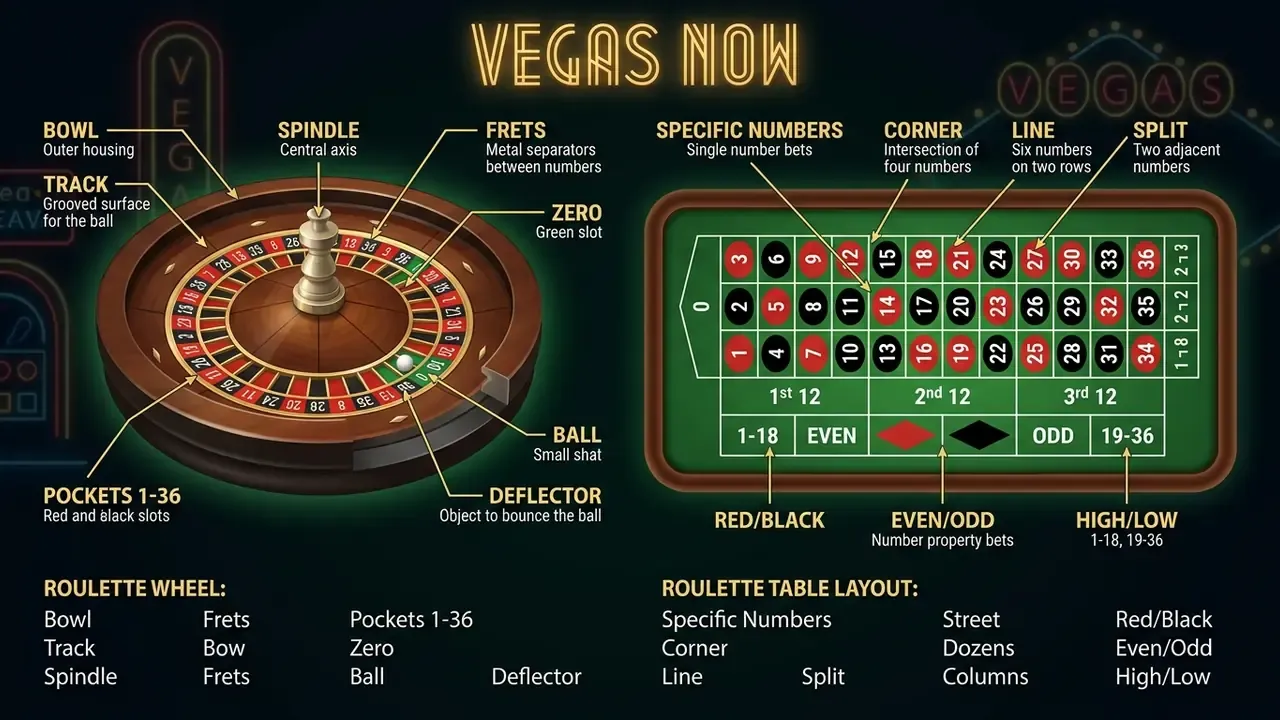
Diagram contents, in words:

  • Wheel side:outer ball track, numbered pockets 0 to 36, the green zero pocket, rotor and central spindle.
  • Table side:the single zero box, the inside bet zone (straight-up, split, street, corner, six line) and the outside bet zone (dozens, columns, red/black, odd/even, high/low).
  • Racetrack:an oval wheel map used for French call bets such as Voisins du Zéro, Tiers du Cylindre and Orphelins.
  • Dealer area:the croupier's working space, where the ball is released and payouts are confirmed.
Vegas Now heading-banner

Roulette Wheel, Table and Chips

The roulette wheel is the randomiser. Numbered pockets sit around a central spindle: 37 pockets on a European wheel (1 to 36 plus a single green zero), and 38 on an American wheel, because of the extra double zero. Structurally the assembly combines a rotating rotor, a hub and spindle, an outer ball track and the pocket ring that fixes the result.

The roulette table grid maps directly onto those numbers and adds zones for grouped outcomes. Players position chips on individual numbers, dividing lines or boundary boxes to signal the wager type. Each chip colour or denomination carries a defined value, so every bet stays traceable across the layout until the spin resolves. At multi-player tables, coloured chips exist purely to identify ownership, which stops two players' stakes on the same number being confused.

Worth noting: the numbers on the wheel are not arranged in the same order as the numbers on the cloth. Reds and blacks alternate on the rotor, and neighbouring numbers on the wheel sit far apart on the table. That is exactly why the racetrack interface exists.

Roulette Wheel, Table and Chips. The

Roulette Rules: How a Round Runs and How You Place Bets

Standard roulette rules follow a sequential loop built for order and auditability. Each round opens when the dealer declares the table live for wagering, and players then place their bets on the grid.

As the wheel turns, players keep positioning chips until the dealer, or the automated interface, announces that no more bets are accepted. The ball travels the outer track, drops, and settles. The croupier or the software identifies the winning number, sweeps losing chips from the roulette table, then pays winners at fixed odds. Learning this rhythm matters when playing either format, mostly so you avoid missed wagering windows and accidental chip drops.

  1. Select a verified table. Choose a format (European RNG, French, or live dealer) with limits you can comfortably fund, and confirm the licence and provider first.
  2. Acquire chips. Convert your balance into digital chips, or pick a chip denomination from the selector.
  3. Place bets on the layout. Position chips on inside numbers or outside categories before the cutoff.
  4. Watch the spin cycle. Wait while the wheel rotates and the ball settles into a pocket.
  5. Verify the result. Compare the landed number against your stakes, then check the automated balance update.
Roulette Rules How a Round Runs

The Zero Rule and French Roulette Outcomes

Here is the detail newcomers miss most often. When the ball drops into the green 0 (or 00 on American tables), every standard outside wager (red/black, even/odd, high/low, columns, dozens) is settled as a loss, unless a regional rule intervenes:
  • La Partage (French rules):on an even-money bet, a zero result costs you only half your stake, which pulls the house edge on those bets down to 1.35%.
  • En Prison:your even-money bet is locked for one further spin. If it wins next round, the original stake is returned with no additional payout.
  • No effect on inside bets:a straight-up wager on 0 still pays 35:1, and split, street or corner bets covering the zero sector settle as normal.
The Zero Rule and French Roulette

So a red/black bet on a European table is not a true coin flip. The zero pocket belongs to neither colour group, and that single pocket is the structural source of the house edge. Everything else is decoration.

Beginner's Guide: How to Start to Play Roulette Online

To start with casino roulette sensibly, pick a single-zero European or French table. The house edge is 2.70% rather than the 5.26% you accept on American layouts, and that gap compounds over hundreds of spins. Before committing real funds, get familiar with the interface, chip values and control buttons. Free-play modes exist for precisely this reason: to let you confirm table limits, bet types and payout structure before a deposit.

Early on, most beginners do better focusing on outside positions such as red or black, odd or even, where payouts are 1:1 and hits arrive far more often. The preference is verifiable, not folklore. Those wagers cover 18 of 37 pockets, giving a 48.65% hit rate on a European wheel, and the same simulation dataset that confirmed the 2.70% edge on single numbers also shows even-money positions carry the lowest variance of any standard roulette wager.

Beginner's Guide How to Start to

«For a single-number bet in European RNG roulette the win probability was exactly 2.7% and the house edge 2.7%.» - Roger.com, Live Dealer Games Versus RNG Games: How The Wins Differ (2023). https://www.roger.com

Watching a handful of automated or live spins without heavy stakes also helps you learn dealer calls, timing limits and how the interface flags balance changes.

Roulette Bets and Odds: What to Weigh Before Staking

Assessing roulette bets means comparing payout multipliers against real odds. Betting on a roulette table splits into two families: inside bets and outside bets.

Inside wagers cover single numbers or tight clusters (straight-up, split, street, corner). Payouts run high, up to 35:1 on a single number, but the probability of a hit is only 2.70% on a European wheel. Outside wagers cover groups of 12 to 18 numbers, including columns, dozens and red/black. Their odds are far friendlier, up to 48.65%, and their payouts correspondingly modest at 1:1 or 2:1.

An empirical analysis published by Roger.com (2023) reviewed more than 100,000 simulated spins of European roulette online. Single-number bets held a strict 2.70% win rate and an exact 2.70% house edge, which demonstrates that expected value stays constant no matter how you spread chips around the board.

Roulette Bets and Odds What to
Bet TypeLayout PositionPayoutWin Odds (European, 37 pockets)Risk Level
Straight-UpSingle number box35:12.70% (1/37)High, high variance
SplitLine between 2 numbers17:15.41% (2/37)High
StreetRow of 3 numbers11:18.11% (3/37)Medium-high
CornerIntersection of 4 numbers8:110.81% (4/37)Medium
Six LineTwo adjacent rows (6 numbers)5:116.22% (6/37)Medium
Column / Dozen12-number group box2:132.43% (12/37)Moderate
Even-Money (Red/Black, Odd/Even, High/Low)Outside boundary boxes1:148.65% (18/37)Low, low variance
Top Line / Five-Number Bet (American only: 0-00-1-2-3)Top edge of the layout6:113.16% (5/38)Extreme (house edge 7.89%)
Straight-Up in multiplier games (e.g. Lightning Roulette)Single number box29:1 base plus multipliers, up to 499:12.70% (1/37)High, very high volatility
Even-Money under La Partage (French rules)Outside boundary boxes1:1, half stake returned on 048.65% (18/37)Low (house edge 1.35%)

Read that table alongside the variant table below. The layout you sit at changes your long-run cost more than any betting pattern ever will.

VariantPocketsZero sectorsHouse edge (standard bets)Even-money edge
French roulette37Single 0 plus La Partage / En Prison2.70%1.35%
European roulette37Single 02.70%2.70%
American roulette380 and 005.26%5.26%
Triple-zero variants390, 00 and a third sectorabout 7.69%about 7.69%

A quick illustration of what those percentages mean in dollars. Stake $2 per spin for 200 spins at a moderate pace, roughly one hour of RNG play, and you turn over $400. Expected cost on a European table is about $10.80. On an American table it is about $21. Same game, double the bill.

This information is general in nature and does not replace professional advice. Gambling involves financial risk. Please play responsibly.

Roulette Demo vs Roulette Real Money

Choosing between a roulette demo and roulette real money comes down to financial exposure and what you are trying to learn. A demo runs entirely on virtual credits inside a closed loop, so you can test navigation, bet placement and rules with nothing at stake.

Play for real, and every bet carries a direct consequence. Real-money tables also bring identity verification (KYC), withdrawal conditions and the need for personal limits set before, not during, a session.

This information is general in nature and does not replace professional advice. Real-money wagering carries the risk of losing your entire deposited balance.

Roulette Demo vs Roulette Real Money

⚠️ ALERT: FINANCIAL RISK AND DEMO UTILITY

Roulette real money play and money bets involve financial risk and a permanent mathematical house edge. Wagered funds can be lost in full. Free roulette demo modes give you a safe environment to study rules, layouts and pacing without risking capital. Demo results never predict real-money outcomes.

Longitudinal population research from the Australian National University shows overall gambling participation has broadly stabilised since 2023, while engagement continues shifting toward digital channels.

«Overall gambling participation among Australian adults was 60.3% in 2024, with a long-term shift toward online wagering.» - Suomi, Hahn & Biddle, Gambling participation in Australia 2024, ANU Centre for Social Research and Methods. https://www.anu.edu.au

Related work by Russell et al. (2023) and Flinders University (2023) notes that simulated casino environments can teach mechanics without financial risk, provided the player understands that success on virtual credits changes nothing about the probabilities of monetary play.

When to Choose Roulette Demo

Use a roulette demo when you meet a new software provider, test an unfamiliar side bet, or move between rule sets, say from European to French, or from a classic table to a multiplier variant. Demo mode is also the cheapest way to see how custom bet templates behave, how minimum and maximum limits are enforced, and how the interface reacts under real-time countdowns.

Still, demo play is a technical rehearsal, not a harmless introduction to gambling. Simulated wagering has measurable behavioural effects, particularly among younger users:

«Young people who played simulated gambling games at 16 to 17 were 40 percentage points more likely to gamble with money at 18 to 19.» - Sekata & Jenkinson, AGRC Video Notes, Australian Gambling Research Centre (2023). https://www.agrc.org.au

In our editorial work on iGaming guidance, the complaints we see from newcomers are rarely mathematical. They are mechanical: the wrong chip denomination selected, a chip dropped on a boundary line instead of inside the number box, a stake confirmed after the cutoff. Rehearsing in free play removes those avoidable errors before real money is on the felt. We present that as editorial observation rather than measured data, since controlled onboarding research on this specific point remains thin.

Roulette Live Dealer and Roulette Live Casino: How the Format Works

The roulette live dealer format sits between a physical table and a digital lobby. Streams come from purpose-built studios or licensed gaming floors, where a human dealer spins a real wheel while optical sensors convert the landing pocket into game data.

In a roulette live casino session you place wagers through a digital overlay while watching high-definition video of the actual spins. Physical feedback, automated settlement. The trade-off is pacing: rounds run on dealer schedules and fixed countdown timers, not on your clicks.

«Live dealer roulette shows higher variance because of the physical characteristics of the wheel, although the mathematical house edge remains 2.7%.» - Roger.com, Live Dealer Games Versus RNG Games: How The Wins Differ (2023). https://www.roger.com

For bankroll planning that distinction is genuinely useful. Identical expected value with wider short-term swings means a live session can empty a small balance faster during an unlucky run, even though the long-run cost per unit staked is unchanged.

High-Multiplier Live Tables (Lightning and Quantum Variants)

Modern live studios also run modified European tables that fold RNG payout multipliers into the broadcast:
  • Lightning Roulette (Evolution):once betting closes, one to five "Lucky Numbers" are struck by lightning, lifting straight-up payouts from 50x to 500x.
  • Quantum Roulette (Playtech):applies random Quantum Multipliers up to 500x, with event triggers that can push multipliers higher on selected numbers.
  • Roulette Xtra and comparable hybrids:after "no more bets", four or five numbers receive boosted straight-up payouts, commonly from 30:1 up to 200:1.
  • The trade-off:to fund those boosts, non-multiplied straight-up bets pay 29:1 or 30:1 rather than 35:1. Outside bets keep standard odds, which is why multiplier tables spike volatility while leaving even-money play mathematically identical.
High-Multiplier Live Tables Lightning and Quantum

Fun to watch, expensive to grind. Treat them as entertainment products, not value plays.

Format Comparison: Demo vs RNG vs Live Dealer

CriterionFree DemoRNG Online RouletteLive Dealer Roulette
Outcome engineCertified RNG (virtual credits)Certified RNGPhysical wheel plus OCR sensors
Round speedPlayer-controlled, instantPlayer-controlled, about 15 to 25 secondsFixed dealer cycle, about 40 to 60 seconds
Minimum stakeNone (virtual chips)Typically the lowest availableUsually higher than RNG tables
Table availabilityUnlimited instancesUnlimited instancesLimited by studio capacity
Financial riskNoneFull stake at riskFull stake at risk
VarianceSame maths, no consequenceStandardHigher short-term variance
Best suited toLearning rules and interfaceFast, low-stake sessionsAtmosphere, transparency, social play
Extra featuresUnlimited experimentationAutoplay, statistics, quick-betChat, racetrack, multipliers, saved bets

Live Croupier or Standard Digital Interface: Which to Choose?

The choice between a studio feed and standard digital roulette online comes down to speed, atmosphere and availability.

RNG tables settle instantly through certified algorithms, which suits short sessions and small stakes. Live tables offer a social feel, a visible wheel and chat, but they carry higher minimums and fixed timers. Seats and dealer throughput also cap capacity, so popular variants can be full at peak hours, whereas digital tables simply spin up another instance.

🔍 FACT CHECK: LIVE CASINO INTEGRITY STANDARDS

Verified roulette live dealer operations run in regulated studios with physical European or American wheels, professional croupiers and Optical Character Recognition (OCR) cameras. Result validity rests on continuous video recording, real-time sensor logging and independent audits from bodies such as eCOGRA or iTech Labs, alongside operator licensing. Conditions at individual casino roulette tables still vary, so check limits, rules and the studio name in the game info panel.

Streaming culture adds one more behavioural layer worth weighing before you treat live tables as passive viewing:

«Watching roulette and poker streams can increase the likelihood of gambling participation; streams frequently include links to external casino sites.» - University of Sydney, Influencer gambling is on the rise (2025). https://www.sydney.edu.au

Interface Features and Table Etiquette

Mobile app or physical floor, the operational habits are much the same:

  1. Saved and favourite bets. Store complex multi-chip patterns such as Orphelins or Voisins du Zéro, then place them in one tap inside a 15-second live window.
  2. Spin history and statistics panel. Licensed interfaces display past results, hot and cold numbers, colour distribution. Informational only. Previous outcomes carry no predictive weight.
  3. Racetrack layout. An oval map of the wheel that lets you back physical sectors rather than grid positions.
  4. Rebet and double-rebet controls. Handy, but they repeat the previous stake exactly. Check the figure before confirming, especially after a progression sequence.
  5. Cashing-out etiquette. Digital balances credit instantly. At physical or hybrid live tables, coloured table chips hold no value away from that table, so redeem them for cash chips with the dealer before you leave.
  6. Hands off after the call. Once "no more bets" is announced, do not touch or move chips. In live studios that is monitored on camera, and disputes get resolved from the recording.
Interface Features and Table Etiquette. Mobile

Payment Methods and Bonus Terms for Australian Roulette Players

Most avoidable losses do not happen at the wheel. They happen around it, in payment friction and misread bonus terms. Australian users typically meet the following rails:

MethodTypical deposit speedTypical withdrawalNotes for roulette players
PayID / bank transferNear-instant1 to 3 business daysBank-verified name matching; some issuers decline gambling-coded transactions
Visa / Mastercard (debit)InstantOften unsupported for payoutsAustralian credit cards are restricted for online wagering
Prepaid vouchers (e.g. Neosurf)InstantDeposit onlyUseful as a hard spending cap
e-walletsInstantHours to 2 daysCheck whether e-wallet deposits void bonus eligibility
CryptocurrencyMinutesMinutes to hoursNetwork fees and price swings apply; no chargeback protection

Before depositing anywhere, run a three-step verification check:

  1. Licence trace. Find the licence number in the site footer, then confirm it on the regulator's own register. Never through a logo image or a link the operator supplies.
  2. KYC and payout terms. Read the identity requirements, minimum and maximum withdrawal amounts, processing windows and per-transaction fees.
  3. Game provider verification. Open the game info panel and confirm the studio name and RTP statement. Cloned or unbranded roulette tables with no provider attribution are a red flag.

The bonus trap: game weighting. Roulette is among the least bonus-friendly games in any lobby. Because even-money bets cover close to half the wheel, operators assign table games a low contribution rate, commonly 0% to 10% of each wager, against 100% for pokies. A $100 bonus with 30x wagering and 10% roulette weighting effectively demands $30,000 in roulette turnover, not $3,000. Read that number twice.

Further restrictions usually appear in the same terms: maximum bet caps while a bonus is active, bans on covering more than a set share of the layout, and forfeiture clauses aimed at "low-risk" patterns such as backing red and black at once. Five minutes with the weighting table is the highest-value reading a roulette player can do.

Who should skip a roulette bonus entirely? Anyone who plans to play only even-money bets, anyone uncomfortable with max-bet caps, and anyone who wants withdrawals available at short notice. A clean deposit with no bonus attached keeps your balance liquid and your rules simple.

Before depositing anywhere, run a three-step

Roulette Strategy: Using Rules and Odds Without Chasing Myths

A roulette strategy structures stake sizing and bankroll allocation. It cannot alter the house advantage. Systems such as the Martingale (doubling after a loss) or the Fibonacci progression reshuffle variance and short-term chip flow, yet each spin stays an independent event with the same fixed odds.

Worked counter-example: how Martingale breaks. Start at $5 on red with a $500 bankroll, at a table capped at $500 per even-money bet. A losing run escalates the stake to $10, $20, $40, $80, $160, $320, and the eighth required wager is $640, above the table maximum. By then you have staked $635 and cannot legally place the bet that would recover it. The odds of eight consecutive non-red results on a European wheel sit near 0.5%, roughly once in 200 sequences, which is close to inevitable across a few hundred spins. The system does not fail through bad luck. It fails because table limits and finite bankrolls are structural, while the 2.70% edge is permanent.

Research from the University of Sydney (2025) on digital gambling behaviours points at the same cognitive trap: players who believe past results shape future spins tend to lose more, not less.

Roulette Strategy Using Rules and Odds

«Cognitive errors, in particular the belief that past spins influence future ones, systematically increase player losses.» - University of Sydney, Digital gambling behaviours research (2025). https://www.sydney.edu.au

Since the edge holds at 2.70% on European wheels across every standard combination, and 1.35% on even-money bets only where La Partage applies, a sustainable approach is procedural rather than clever. Set deposit limits. Define a stop-loss and a stop-win before the first spin. Cap session length. Use self-exclusion tools when they are needed. And treat all online games as recreation with a cost, never as income.

«Adolescents who played social casino games in the past month had 2.5 times higher odds of meeting criteria for gambling disorder.» - Flinders University, Not all games are created equal, Addictive Behaviours (2023). https://www.flinders.edu.au

If you are still comparing formats, providers or table conditions, test the mechanics of online casino games in free-play mode first, and read any promise of a "winning roulette system" as marketing copy rather than mathematics.

Always review current terms and the regulatory conditions that apply where you live. Where gambling is legal, set personal spend limits before you place a wager, and use safer gambling tools if play stops feeling recreational.

How We Review Roulette Tables and Casino Brands

Short version of our method, so you can repeat it yourself in about ten minutes:

  1. Legality and licence status for players in Australia, checked on the regulator's register rather than the site footer graphic.
  2. Variant and RTP disclosure. Single zero available? Is French La Partage offered? Does the info panel state the RTP and the provider?
  3. Bonus terms in full. Wagering multiple, roulette weighting, max bet while bonused, expiry window, max cashout.
  4. Withdrawal reality. Documented processing times, KYC requirements, fees, minimum and maximum payouts.
  5. Complaint history. Patterns matter more than one angry post: repeated reports about delayed payouts, reversed winnings or unexplained account closures are the clearest red flags.
  6. Responsible gambling tools. Deposit and loss limits, session reminders, cooling-off, self-exclusion.
  7. Support quality. Test live chat with one specific question about roulette weighting before you deposit. The answer, or the silence, tells you plenty.

Compare three to five brands against those seven points and the shortlist usually writes itself. If a brand fails point one, nothing later on the list can rescue it.

How We Review Roulette Tables and

Responsible Gambling Support in Australia

🛟 NEED SUPPORT? FREE, CONFIDENTIAL HELP IS AVAILABLE

  • BetStop, the National Self-Exclusion Register: a free service letting Australian residents block themselves from all licensed Australian interactive wagering providers, for periods from three months to life. Registration is confidential and takes minutes.
  • Gambling Help Online: free counselling and chat, 24 hours a day, on 1800 858 858.
  • Lifeline: 13 11 14 for immediate crisis support.
  • Controls you can set today: deposit limits, loss limits, session-time reminders, cooling-off periods, and removing stored payment methods.

Gambling is entertainment with a negative expected value, not an income strategy. If wagering is affecting your finances, sleep, work or relationships, ask for support early.

Disclaimer. This guide provides general information about game mechanics, probabilities and regulatory context. It is not financial, legal or medical advice, and it is not an inducement to gamble. Gambling involves the risk of losing money. The availability and legality of online casino products vary by jurisdiction, so verify the rules that apply to you. 18+ only.

FAQ: Online Roulette Questions from Australian Players

Can you place a chip on every number in online roulette?

Yes, and it is mathematically pointless. Covering all 37 numbers on a European wheel costs 37 units. A winning straight-up bet pays 35:1 plus your 1-unit stake, so 36 units come back. You guarantee a net loss of exactly one unit per spin. That is the house edge, made visible.

Does European roulette have better odds than American roulette?

Yes. European roulette uses a single zero (2.70% house edge), while American roulette adds a double zero (5.26%). French roulette with La Partage is better again, trimming the even-money edge to 1.35%. Choose single-zero layouts whenever they are on offer.

Are online roulette outcomes truly random?

Licensed digital tables use random number generators audited by independent laboratories such as eCOGRA or iTech Labs. Live dealer games use physical wheels verified through optical sensors, continuous video recording and real-time result logging, alongside operator licensing requirements.

What happens to my red/black bet if the ball lands on zero?

On standard European and American tables every outside bet loses, red/black included, when zero or double zero wins. Under French La Partage you get half the even-money stake back. Under En Prison the wager is held for one further spin.

Does roulette count toward casino bonus wagering requirements?

Usually only in part. Roulette commonly contributes between 0% and 10% of each wager toward wagering, and the same terms often cap maximum bets or ban low-risk patterns. Read the game-weighting table before opting in.

Can I play roulette on a mobile phone?

Yes. RNG and live dealer tables both run in mobile browsers or apps, with portrait layouts, simplified chip selectors and saved-bet buttons built for short wagering windows. Make sure your connection is stable, because a dropped connection mid-round does not void the wager.

Why do live dealer tables have higher minimum bets?

Live tables need studio infrastructure, cameras and salaried croupiers, and each table handles a limited number of rounds per hour. Higher minimums offset those fixed costs, which is why RNG tables generally suit smaller bankrolls.

How long do withdrawals take?

That depends on the rail and on verification. Bank and PayID payouts usually clear in one to three business days, e-wallets within hours, crypto within minutes, but only once KYC is complete. Finish verification before you request a withdrawal and you remove the most common delay.

Is there any roulette strategy that beats the house edge?

No. Progressions and sector systems change how your bankroll rises and falls, not the expected cost of each spin. The closest thing to an edge-reducing decision is choosing a French single-zero table and betting even money, which lowers the edge to 1.35%.

About This Guide

This guide was written and fact-checked by the editorial team behind our iGaming content standards, which focuses on probability-verified explanations of casino table games, licensing frameworks and consumer-protection requirements. Editorial oversight: Claire Bennett, Senior iGaming Content Editor, a senior editorial persona who reviews every probability table, payout ratio and regulatory statement against primary regulator publications and peer-reviewed research before publication.

The mathematical claims here are reproducible. Every probability is derived straight from pocket counts (1/37, 18/37, 5/38 and so on), so you can check them yourself with a calculator, no spreadsheet required. Terms, weightings and processing times change, so treat the last-reviewed date at the top as part of the information.